TEF-Health Robotics
Test. Validate. Accelerate.
Healthcare robotics, ready for the real world.
From prototype testing to clinical evidence, access a cross-European network of hospitals, research laboratories and robotics experts.
Tell us about your technology, intended use and development stage. TEF-Health Robotics will identify the most relevant expertise, facilities and evaluation pathway across the network.
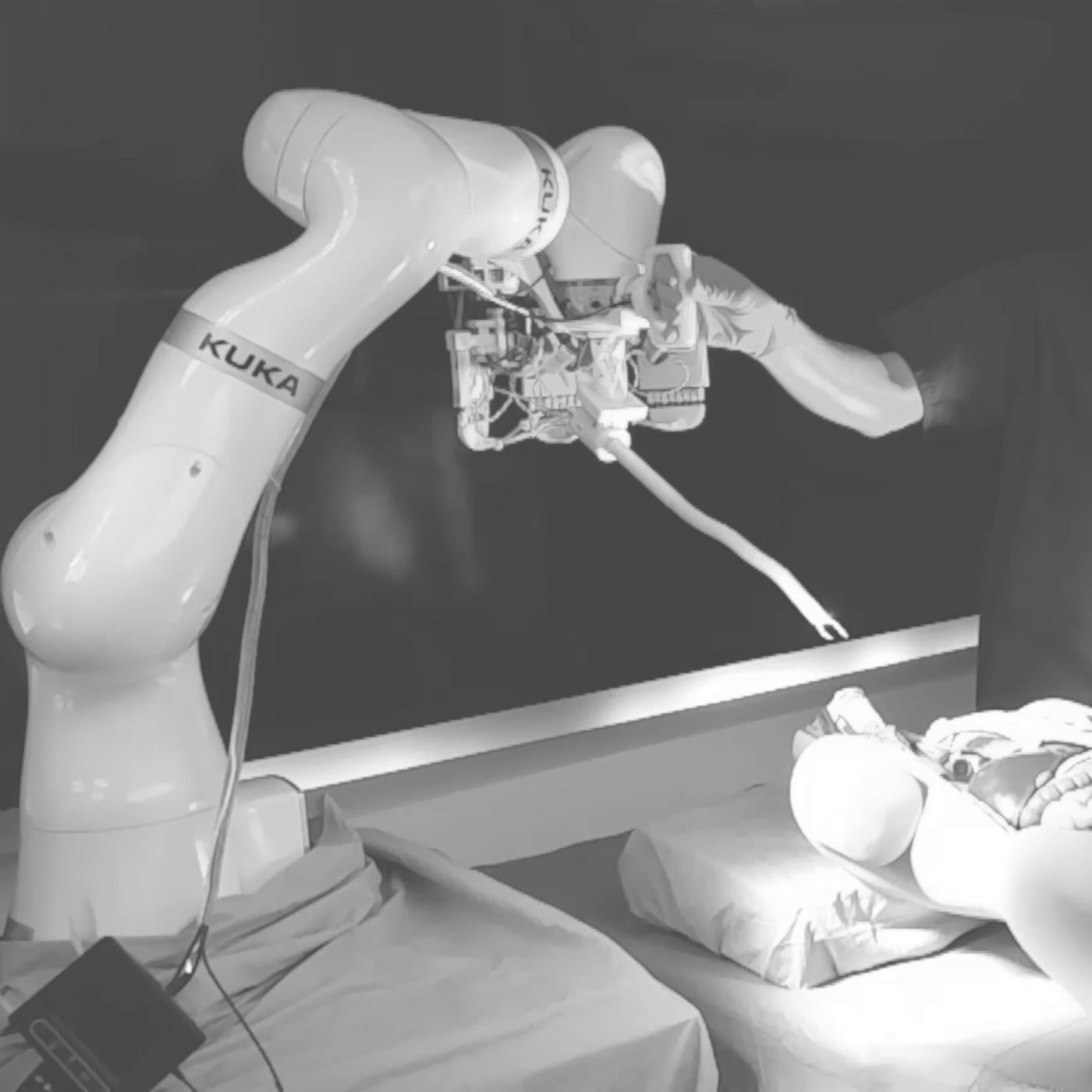
Picture: Berthet-Rayne et al., 2018, CC BY 4.0, cropped and tinted

- Centre Hospitalier Universitaire De Grenoble (CHUGA) France
- Commissariat A L Energie Atomique Et Aux Energies Alternatives (CEA) France
- Fondazione Istituto Italiano Di Tecnologia (IIT) Italy
- Fraunhofer-Institut für Integrierte Schaltungen (IIS) Germany
- Hospices Civils De Lyon (HCL) France
- Instituto Pedro Nunes Associacao Para A Inovacao E Desenvolvimento Em Ciencia E Tecnologia (IPN) Portugal
- Politecnico Di Milano (POLIMI) Italy
- Technische Universitaet Muenchen (TUM) Germany
From technology to evidence: testing robotics in healthcare.
Healthcare robotics face challenges that cannot be solved in the lab alone. Safety, clinical performance, human–robot interaction, usability, workflow integration and regulatory compliance all need to be addressed in the complexity of healthcare environments.
TEF-Health helps robotics SMEs test and validate their solutions in real and simulated hospital environments — physical and in-silico — combining technical, clinical, ergonomic and organisational perspectives.
One network. The expertise you need.
Access complementary European capabilities through one coordinated robotics network. Our partners bring together university hospitals, robotics and AI research, human factors, simulation, clinical research and regulatory expertise.
| Challenge | What we help you do | Evidence you can build |
|---|---|---|
| Does it work in a hospital? | Test performance, reliability, safety and workflow integration in representative environments. | Technical and operational performance data |
| Will people use it? | Involve surgeons, nurses, clinicians, patients or caregivers in design and evaluation. | Usability, acceptance and human-factors evidence |
| Can it demonstrate clinical value? | Design and support clinical investigations and clinical evaluation. | Structured clinical evidence |
| Is it ready for market access? | Support alignment with European regulatory requirements and relevant standards. | Regulatory and quality documentation |
Choose the pathway and services that fit your robot
- Simulated operating-room testing with phantoms
- Co-design workshops with surgeons and nurses
- Formative and summative usability evaluation
- Impact and acceptability assessment
- Pre-clinical trial
- Clinical investigations and clinical-trial documentation
- End-user workshops with healthcare professionals
- Functional and performance testing in simulated hospital environments
- Assessment of reliability, navigation, safety and interaction with staff
- Real-world evaluation of workflow impact and acceptance
- Usability and human-factors evaluation
- Clinical studies
- Design and development support
- Evaluation of remote clinical workflows and user experience
- Focus groups and expert panels
- End-user design and healthcare requirements
- Human–robot interaction design and testing
- Functional/performance testing in simulated environments
- Real-world impact and acceptance evaluation
- Ergonomic testing
- Clinical and safety assessment
- Integration of end-user and medical-staff feedback
- Regulatory support
- Biomechanics and human–robot interaction expertise
Healthcare robotics: examples and use cases
-
HCLMobile logistics robot
From simulated hospital to real deployment
A robotised logistics system for surgical instruments was first evaluated through defined use cases, test scenarios and quantitative performance indicators. At Station H, testing reproduced hospital constraints such as corridors, doors, obstacles and human presence. The solution was then evaluated in real hospital conditions with healthcare professionals, combining engineering and ergonomics.
-
CHUGASurgical robotics
Building multicentre clinical evidence
After CE marking, Imactis sought broader evidence of clinical benefit for its electromagnetic-navigation solution for CT-guided interventional radiology. CHUGA supported a multicentre study across eight university hospitals, involving 450 patients and junior and senior radiologists. The results demonstrated significant clinical benefit.
-
IPN & CHUCTelemedicine robot / RoboH
Generating clinical data for CE marking
RoboH enables remote ultrasound examinations through robotic stations connecting clinician and patient. Its clinical investigation assesses diagnostic agreement, image quality, completeness of anatomical views, procedure time, technical success, usability, workload, participant experience and safety. The study is intended to generate clinical data supporting clinical evaluation and completion of CE marking.
-
POLIMISocial robot in nursing homes
Adapting robotics to the realities of care
An SME worked with POLIMI to adapt an existing robotic solution to healthcare. Nursing homes and expert panels helped identify user needs, relevant tasks and potential risks. The robot was then adapted and tested with particular attention to interaction with frail users and personal information.
-
CEAEMY exoskeleton + WIMAGINE BCI
From TRL4 to clinical evaluation
CEA integrated the EMY four-limb exoskeleton with the WIMAGINE brain-computer interface and carried out clinical evaluation with tetraplegic participants. The use case illustrates a pathway from early-stage technology through regulatory qualification and clinical evaluation, from TRL4 to TRL6.
Why work with TEF-Health?
- Access a coordinated European network rather than a single testing site.
- Combine clinical insight with robotics engineering, human factors, AI, simulation and regulatory expertise.
- Test earlier in realistic or simulated environments before exposure to routine clinical workflows.
- Generate structured evidence on safety, performance, usability, acceptance and workflow impact.
- Support the pathway from prototype development through clinical evaluation and market readiness.
Have a robotics project to test or validate?
Tell us about your technology, intended use and development stage. TEF-Health Robotics will identify the most relevant expertise, facilities and evaluation pathway across the network.